The best local ElevenLabs alternatives for 2027
The apps and open models worth running on your own computer instead of ElevenLabs, with what each one replaces, the hardware it needs and the licence terms that decide commercial use.
Comparisons17 min read
On this page
- The short version
- What ElevenLabs costs at the end of 2026
- What running locally changes
- How we chose
- Desktop apps you can use without code
- Echova Studio
- VoiceStudio
- Voicebox
- Applio for voice changing
- Ultimate Vocal Remover for voice isolation
- pyVideoTrans for dubbing
- Transcription
- Open models for developers
- Qwen3-TTS
- VoxCPM2
- Kokoro
- Pocket TTS
- Chatterbox
- OmniVoice
- The non-commercial heavyweights
- Which local tool replaces which ElevenLabs feature
- What hardware you need
- Licences: read them before you publish
- What to watch in 2027
- Which one should you pick?
- Frequently asked questions
- Is there a free local alternative to ElevenLabs?
- Does local text to speech sound as good as ElevenLabs?
- Do I need a GPU?
- Can I use local AI voices commercially?
- Will my files be uploaded?
- Is voice cloning legal?
- Sources
ElevenLabs is still the name most people reach for when they need an AI voice. It sounds good, it's fast, and it covers nearly every voice job: text to speech, cloning, dubbing, transcription, voice changing and noise removal. It also runs on credits, and every script, recording and video you give it goes to its servers.
If either of those is a problem for you, local tools caught up for most everyday work during 2026. Open models from Alibaba, OpenBMB, Kyutai and others now clone a voice from a few seconds of audio on a normal computer, and several desktop apps wrap them so you never touch Python. This guide covers the apps and models we think are worth your time going into 2027, which ElevenLabs feature each one replaces, the hardware it needs, and the licence terms that decide whether you can use the output commercially.
We make Echova Studio, one of the apps on this list. We've described every tool the way its own docs and licence describe it, and the sources are linked at the end so you can check our work.
The short version
- For one app that does voiceovers, cloning, dubbing and transcription without code, try Echova Studio, VoiceStudio or Voicebox. All three are free to start and run on Mac and Windows.
- If you're building a product and need licences that allow commercial use, start with Qwen3-TTS or VoxCPM2 (both Apache 2.0), and use Kokoro when preset voices are enough.
- On a computer with no graphics card, Pocket TTS and Kokoro run comfortably on the CPU.
- For the best possible sound in personal or research work, look at Fish Audio S2 Pro, Voxtral TTS and Higgs Audio V3. None of them allow commercial use for free.
What ElevenLabs costs at the end of 2026
ElevenLabs sells a monthly allowance of credits. On most of its voice models one character of text costs one credit, so 1,000 credits buys roughly a minute of speech. These were the plans on its pricing page in November 2026:
| Plan | Price per month | Credits per month | Text to speech, roughly |
|---|---|---|---|
| Free | $0 | 10,000 | 10 minutes |
| Starter | $6 | 30,000 | 30 minutes |
| Creator | $22 | 121,000 | 121 minutes |
| Pro | $99 | 600,000 | 600 minutes |
| Scale | $299 | 1.8 million | 1,800 minutes |
| Business | $990 | 6 million | 6,000 minutes |
The free plan has no commercial licence, so anything you publish for a client or a monetised channel needs Starter or above. Instant voice cloning starts on Starter, and professional voice cloning on Creator.
Every product draws from the same credit pool, and the tools other than text to speech cost more. Speech to text uses about 330 credits per minute of audio, Voice Changer and Voice Isolator about 1,000, and dubbing between 2,000 and 10,000 credits per minute depending on the type. Dubbing one 10-minute video can therefore use anything from 20,000 to 100,000 credits, and the top of that range is most of a Creator month.
A local tool has no meter. You pay in disk space, electricity and waiting time, and how long you wait depends on your machine.
What running locally changes
A local voice tool downloads its models once and then generates speech on your computer. After setup it works offline, and your scripts, recordings and videos stay on your drive. That's the main reason teams that handle client material or unreleased products look for one.
Quality now depends on the model you choose. The best open models are close to ElevenLabs for plain narration, but ElevenLabs' newest model still ranks above most of them in blind listening tests such as the Artificial Analysis Speech Arena.
Speed depends on your hardware. A small model on a laptop CPU can run faster than real time, while a 4-billion-parameter model wants a graphics card with 16 GB of memory.
The licence becomes your responsibility. "Open weights" only means you can download the model. Many of the best ones forbid commercial use, and some use one licence for the code and another for the weights.
How we chose
Every tool here replaces at least one ElevenLabs feature, runs on your own hardware once it's installed, and could be downloaded in November 2026. We read each project's repository, model card and licence file, because the roundups we found disagree with each other and often get the licence wrong. Where a project licenses its code and weights differently, we list both.
We didn't run our own benchmark for this article. Where we mention a ranking, we name the public listening test it comes from.
Desktop apps you can use without code
Echova Studio
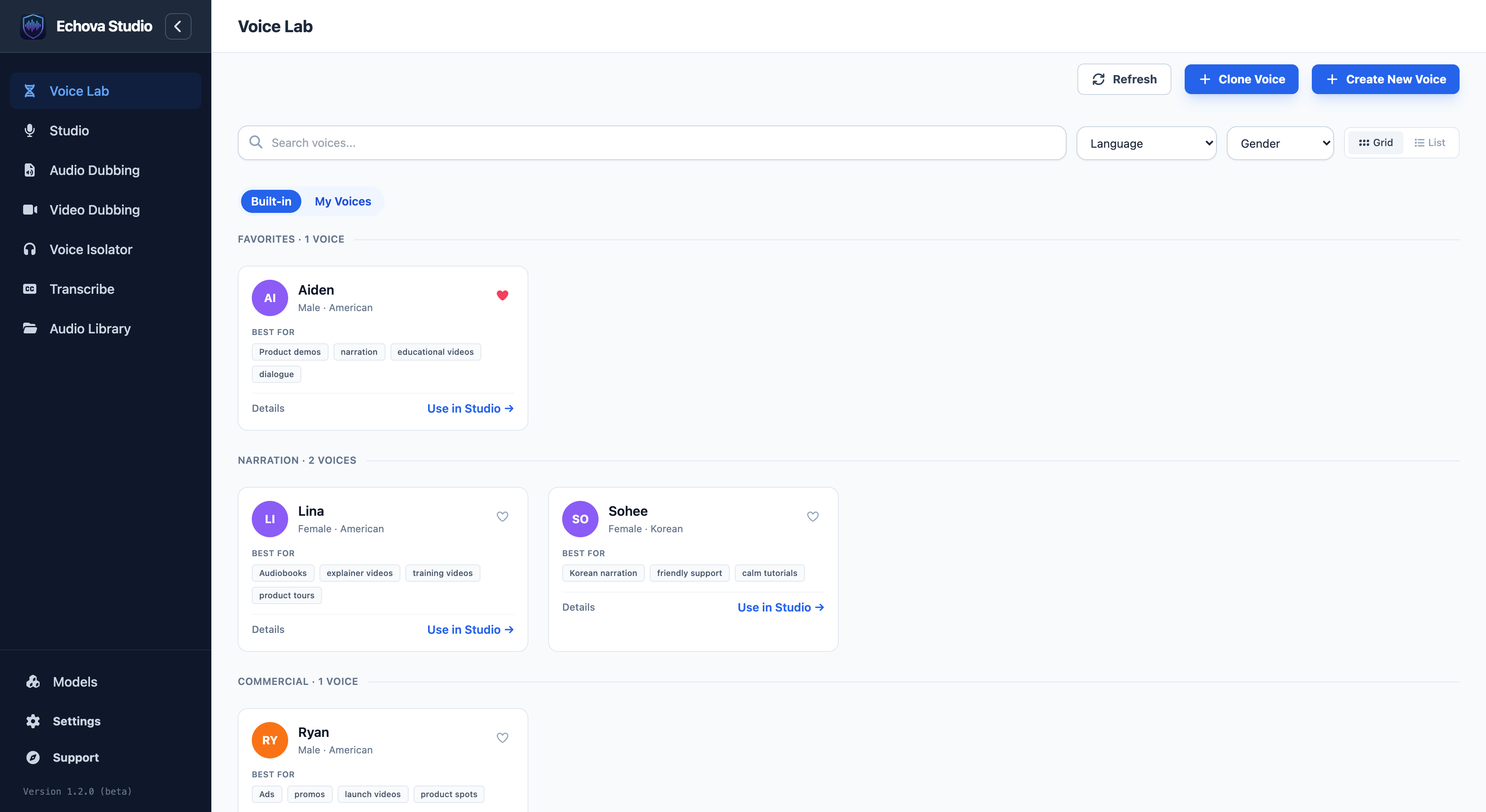
Echova Studio is our app, a desktop studio for macOS 12 or later and 64-bit Windows 10 or later. It does voiceover with 100+ built-in voices, voice cloning, voice design from a written prompt, audio and video dubbing, transcription, dictation, Voice Changer and Voice Isolator.
It bundles open models behind one interface. Pocket TTS handles fast drafts, Qwen3-TTS does multilingual cloning and voice design, VoxCPM gives richer English, the Chatterbox family handles expressive speech and reaction tags such as [laugh], and OmniVoice covers languages the others don't. Transcription runs on faster-whisper, Voice Isolator on Demucs, and dubbing adds NLLB-200 for translation. You install only the models a workflow needs from the Models page.
Lite is free, with no watermark and no generation caps. Pro adds AI enhancement with your own LLM, emotion control, MCP for AI agents and a local HTTP API (pricing). The app runs on a CPU with 8 GB of RAM, and a GPU makes dubbing and the larger models faster. Audio exports as WAV or MP3, and captions as SRT, VTT or TXT.
It suits people who make videos, courses or podcasts and want a finished app with support behind it. It isn't open source, and each bundled model keeps its own licence. Echova marks OmniVoice as non-commercial, for example, so check the model before client work.
VoiceStudio
VoiceStudio is an open-source studio under the AGPL-3.0 licence that calls itself "the open-source, fully-local ElevenLabs alternative". It covers voice cloning, voice design, video dubbing, dictation, transcription and audiobook narration, and claims 646 languages. It runs on more platforms than anything else here: macOS, Windows, Linux, Docker, Android and iOS. Its download page says Intel Macs need a remote backend.
The open-source app is free. VoiceStudio Pro is sold as a commercial licence and adds extras such as remote GPUs and batch processing, so read its terms before you sell what you make with it. The AGPL also matters if you modify the code and offer it to other people over a network.
Voicebox
Voicebox, from Spacedrive creator Jamie Pine, is an MIT-licensed voice studio for Mac and Windows; Linux users build it from source. It clones a voice from a few seconds of audio and speaks 23 languages through seven engines: Qwen3-TTS, Qwen CustomVoice, LuxTTS, Chatterbox Multilingual, Chatterbox Turbo, HumeAI TADA and Kokoro. It also has a global dictation hotkey, a timeline editor for projects with several voices, a REST API, and an MCP tool that lets coding agents talk to you in a cloned voice.
It has the most permissive licence of the three apps. Its feature list centres on speech, cloning and dictation, so for video dubbing you'll want one of the other apps or pyVideoTrans.
Applio for voice changing
ElevenLabs' Voice Changer turns your recording into another voice while keeping your timing and delivery. The closest local equivalent is RVC (retrieval-based voice conversion), and Applio is the easiest way to run it. It's MIT-licensed, runs on Windows, macOS and Linux with no account or telemetry, converts files or live audio, and can train a voice model on your own recordings. Voice models shared online carry their own licences, and Applio's terms require consent from the person whose voice you use.
Ultimate Vocal Remover for voice isolation
For the job ElevenLabs' Voice Isolator does, Ultimate Vocal Remover (UVR) is the standard free tool. It's a desktop app for Windows, macOS and Linux that runs Demucs, MDX-Net and Roformer separation models offline. Roformer models give the cleanest splits but are slow without a GPU. The project recommends an NVIDIA card with 8 GB of memory and supports GPU acceleration for Demucs and MDX-Net on Apple silicon.
pyVideoTrans for dubbing
pyVideoTrans is a GPL-3.0 toolkit that translates and dubs video. It transcribes the speech, translates the subtitles, dubs each speaker and syncs the new audio to the picture. Windows gets a packaged app, and macOS and Linux install from source. It supports local voice cloning engines including Qwen3-TTS, F5-TTS and OmniVoice. Its default voice, Edge-TTS, is an online Microsoft service, so switch every stage to a local engine if you want your files to stay off the internet.
Transcription
Speech to text is the easiest ElevenLabs feature to replace. OpenAI's Whisper large-v3-turbo is MIT-licensed and covers 99 languages. NVIDIA's Parakeet TDT 0.6B v3 is faster, especially on Apple silicon and plain CPUs, and slightly more accurate in English, but it covers 25 European languages and its CC-BY-4.0 licence requires attribution. Echova Studio, VoiceStudio and Voicebox all include transcription and dictation.
Open models for developers
If you're comfortable with Python, or you want to build voice into your own product, these are the models that matter going into 2027.
| Model | Weights licence | Languages | Cloning | Size and hardware | Commercial use |
|---|---|---|---|---|---|
| Qwen3-TTS (Alibaba) | Apache 2.0 | 10 | From about 3 seconds | 0.6B or 1.7B; GPU recommended | Yes |
| VoxCPM2 (OpenBMB) | Apache 2.0 | 30 | Yes, plus voice design | 2B; about 8 GB of GPU memory, or CPU via GGUF | Yes |
| Kokoro (hexgrad) | Apache 2.0 | 8 | No, 54 preset voices | 82M; CPU | Yes |
| Pocket TTS (Kyutai) | CC-BY-4.0, code MIT | 7 | From about 5 seconds | 100M; CPU | With attribution and Kyutai's terms |
| Chatterbox (Resemble AI) | MIT | 23; Turbo is English only | Yes | 350M to 500M; Nano runs on a CPU | Yes, but retired and watermarked |
| OmniVoice (k2-fsa) | Apache 2.0 code; tokenizer under the Higgs Audio 2 licence | 600+ | From 3 to 10 seconds | 612M | Check the tokenizer licence |
| Fish Audio S2 Pro | Fish Audio Research License | 80+ | Yes | 4B plus 400M; GPU | No, paid licence needed |
| Voxtral TTS (Mistral) | CC BY-NC 4.0 | 9 | From about 3 seconds | 4B; 16 GB or more of GPU memory | No |
| Higgs Audio V3 (Boson AI) | Non-commercial research | 100+ | Yes | GPU | No |
| F5-TTS (SWivid) | CC BY-NC, code MIT | English and Chinese | Yes | GPU | No |
| XTTS v2 (Coqui, closed 2024) | Coqui Public Model License | 17 | Yes | About 4 GB of GPU memory | No, and no licence is for sale |
Qwen3-TTS
Alibaba's Qwen team released Qwen3-TTS in January 2026, and it's the safest default for commercial work: code and weights are both Apache 2.0. The Base models (0.6B and 1.7B) clone a voice from about three seconds of audio in ten languages: Chinese, English, Japanese, Korean, German, French, Russian, Portuguese, Spanish and Italian. A separate 1.7B VoiceDesign model creates a new voice from a written description, which makes it the local answer to ElevenLabs' Voice Design. The 0.6B model is a 2.5 GB download and the 1.7B about 4.5 GB.
VoxCPM2
OpenBMB released VoxCPM2 in April 2026. It covers more languages than any other Apache-licensed model on this list, with 30 languages plus nine Chinese dialects, and it outputs 48 kHz audio. It clones voices and can also design one from a text description. It needs about 8 GB of GPU memory, and GGUF builds run it on a CPU through llama.cpp. Its best cloning mode needs a transcript of the reference clip. The older VoxCPM 1.5 covers only Chinese and English.
Kokoro
Kokoro has only 82 million parameters and runs on almost anything, yet in blind listening arenas it ranks above several models many times its size. It ships 54 preset voices across eight languages under Apache 2.0. It can't clone a voice, and its repository hasn't changed since August 2025. For clean narration in a fixed voice on a laptop or a server CPU, it's still hard to beat.
Pocket TTS
Kyutai built Pocket TTS, a 100-million-parameter model, to run on CPUs. By Kyutai's numbers it generates speech about six times faster than real time on a MacBook Air M4's processor. It clones a voice from about five seconds of audio and speaks English, French, German, Portuguese, Italian, Spanish and Dutch. The code is MIT and the weights are CC-BY-4.0, which allows commercial use with attribution. To download the cloning weights you have to accept Kyutai's terms on Hugging Face, which forbid cloning anyone's voice without their consent.
Chatterbox
Resemble AI's Chatterbox was the most widely used MIT-licensed cloning model of 2025 and early 2026. The family includes Turbo (350M parameters, English, with tags such as [laugh] and [cough]), Nano for CPUs, and Multilingual V3 with 23 languages. Every file it generates carries Resemble's inaudible PerTh watermark, and in August 2026 Resemble retired the project. The code stays public under MIT, but there will be no more fixes or releases, so use it freely and avoid building anything that depends on a future version.
OmniVoice
The k2-fsa team, the group behind Kaldi, released OmniVoice in March 2026. It covers more than 600 languages and clones from a 3 to 10 second clip, which is far more language coverage than anything else here. The code is Apache 2.0, but the audio tokenizer inside the released weights uses the Higgs Audio 2 Community License, which requires an extended licence above 100,000 annual active users. Read the licence files on Hugging Face before you ship it in a product.
The non-commercial heavyweights
Fish Audio S2 Pro (80+ languages), Mistral's Voxtral TTS (9 languages, 4 billion parameters) and Boson AI's Higgs Audio V3 (100+ languages) sit near the top of the open-weight models in blind listening tests. All three are free for research and personal projects. For commercial use you buy a licence from Fish Audio, use Mistral's paid API, or leave Higgs out. F5-TTS and Coqui's XTTS v2 have non-commercial weights too, and since Coqui shut down in January 2024 there's nobody left to sell an XTTS licence.
Which local tool replaces which ElevenLabs feature
| ElevenLabs feature | Desktop apps | Open models and tools |
|---|---|---|
| Text to speech | Echova Studio, VoiceStudio, Voicebox | Kokoro, Qwen3-TTS, VoxCPM2, Pocket TTS |
| Instant voice cloning | Echova Studio, VoiceStudio, Voicebox | Qwen3-TTS, VoxCPM2, Pocket TTS, Chatterbox, OmniVoice |
| Voice Design | Echova Studio, VoiceStudio | Qwen3-TTS 1.7B VoiceDesign, VoxCPM2, OmniVoice |
| Dubbing | Echova Studio, VoiceStudio, pyVideoTrans | Whisper, a translation model and a cloning model |
| Speech to text | Echova Studio, VoiceStudio, Voicebox | Whisper large-v3-turbo, Parakeet TDT 0.6B v3 |
| Voice Changer | Echova Studio, Applio | RVC voice models |
| Voice Isolator | Echova Studio, Ultimate Vocal Remover | Demucs, Roformer models |
This guide doesn't cover sound effects, music or ElevenLabs' conversational agents.
What hardware you need
Voice models are much smaller than the language models people run at home, so most of this list works on an ordinary computer.
With no graphics card and 8 GB of RAM, stay with small models: Kokoro, Pocket TTS, Chatterbox Nano or Piper. Piper is small enough for a Raspberry Pi, but it can't clone, and it has been GPL-3.0 since its development moved to the Open Home Foundation in 2025. Whisper transcription works on a CPU but is slow on long files. Echova Studio needs at least a CPU with 8 GB of RAM.
An Apple silicon Mac with 16 GB or more runs most models up to about 2 billion parameters. Check each project's Mac support first, because some only ship for NVIDIA's CUDA. Parakeet is noticeably faster than Whisper on these chips.
An NVIDIA card with 8 to 12 GB of memory handles Qwen3-TTS 1.7B, VoxCPM2, Chatterbox and Roformer vocal isolation comfortably. You only need 16 GB or more for the largest models, such as Voxtral TTS, or for running several jobs at once.
Licences: read them before you publish
The licence decides whether you can earn money from what you make, and it's often stricter than the GitHub page suggests.
- Open weights don't come with commercial rights. Fish Audio S2 Pro, Voxtral TTS, Higgs Audio V3, F5-TTS and XTTS v2 all forbid commercial use under their free licences.
- Some projects license the code and the weights differently. Pocket TTS has MIT code and CC-BY-4.0 weights with extra use terms, and OmniVoice has Apache 2.0 code with a tokenizer under a community licence that caps users. Check the weights, not the licence badge on GitHub.
- Licences change. Fish Audio's community licence, updated in October 2026, allows free commercial use only below $500,000 in annual revenue and never as a hosted TTS service.
- Copyleft apps such as VoiceStudio (AGPL-3.0), pyVideoTrans and Piper (both GPL-3.0) put obligations on people who modify and redistribute the code. The audio you make is governed by the model's licence.
- Chatterbox marks every file with an inaudible watermark. That's harmless for most uses, but you should know it's there.
- Consent applies everywhere. Kyutai's terms and Applio's terms forbid cloning a voice without the speaker's permission, and Echova Studio limits cloning to your own voice or one you have clear permission to use.
What to watch in 2027
The best new models from large labs are increasingly staying closed. When Mistral released Voxtral 3 on October 20, 2026, its TTS model came without downloadable weights, and the March model stayed non-commercial. Expect more of the best voices to arrive as paid APIs, while the strongest freely licensed models keep coming from research groups such as Qwen, OpenBMB, Kyutai and k2-fsa.
Projects also stop. Coqui shut down in January 2024, the original Piper repository was archived in October 2025, and Resemble retired Chatterbox in August 2026. If you build on one model, assume you'll switch at some point, and prefer an app or pipeline that lets you change engines without redoing your work.
Small models keep improving at the same time. Pocket TTS, Kokoro and Chatterbox Nano already produce usable narration on a CPU, so in 2027 the question of whether you need a GPU will matter less for voiceover and more for dubbing long videos.
Which one should you pick?
If you publish videos, courses or podcasts and don't want to install Python, use a desktop app. Echova Studio puts voiceover, cloning, dubbing, transcription and isolation in one supported app, VoiceStudio runs on the most platforms, and Voicebox has the most permissive licence.
If you're building voice into a product, use Qwen3-TTS or VoxCPM2 for cloning and Kokoro for fixed voices, and check the weights' licence again before every upgrade.
If your computer is old or has no GPU, start with Pocket TTS or Kokoro, or an app that offers them.
If you only need transcripts, run Whisper large-v3-turbo, or Parakeet if you work in English or another European language.
If the work is personal or research and you want the best sound available, try Fish Audio S2 Pro or Voxtral TTS, and keep their output out of anything you sell.
Frequently asked questions
Is there a free local alternative to ElevenLabs?
Yes. Echova Studio Lite, VoiceStudio and Voicebox are free desktop apps, and Qwen3-TTS, VoxCPM2 and Kokoro are free models you can use commercially. What you spend is your own hardware and time.
Does local text to speech sound as good as ElevenLabs?
For plain narration, the best open models are close. In Pinggy's August 2026 snapshot of the Artificial Analysis Speech Arena, only one open-weight model, the non-commercial Breeze TTS 2, placed above ElevenLabs' v3. The open models that come closest also tend to be the ones you can't use commercially.
Do I need a GPU?
No. Kokoro, Pocket TTS and Piper run on a CPU, and so does Echova Studio with 8 GB of RAM. A GPU makes the larger models, long dubbing jobs and vocal isolation much faster.
Can I use local AI voices commercially?
That depends on the model, not the app. MIT and Apache 2.0 models such as Qwen3-TTS, VoxCPM2, Kokoro and Chatterbox allow it, and Pocket TTS allows it with attribution. Fish Audio S2 Pro, Voxtral TTS, Higgs Audio V3, F5-TTS and XTTS v2 don't under their free licences.
Will my files be uploaded?
Not if every step runs locally. Watch for tools that mix local and online services; pyVideoTrans, for example, uses an online voice by default. Once its models are downloaded, Echova Studio doesn't upload your audio, video, scripts or project files.
Is voice cloning legal?
Cloning your own voice is fine. Cloning someone else's needs their permission, and many model licences make that a condition of use. Laws on voice likeness differ by country, so get written consent before any commercial project.
Sources
We checked these in November 2026.
- ElevenLabs pricing
- Qwen3-TTS on GitHub
- VoxCPM on GitHub
- Pocket TTS on GitHub and its model card
- Chatterbox on GitHub
- OmniVoice on GitHub and its model files
- Voxtral TTS paper
- Fish Audio S2 and fish-speech on GitHub
- Kokoro on Hugging Face
- VoiceStudio
- Voicebox on GitHub
- Applio
- Ultimate Vocal Remover on GitHub
- pyVideoTrans on GitHub
- Piper on GitHub (Open Home Foundation)
- Artificial Analysis Speech Arena
- Pinggy's open-source TTS roundup, updated August 2026, for the arena standings, Higgs Audio V3 and Kokoro